Last Tuesday you dropped your daughter off at school from your apartment. She forgot her science project at her mom's house — and neither of you realized until the teacher called. That small logistical failure is the kind of thing that keeps co-parents up at night, and it's exactly what a well-designed 50/50 custody schedule prevents.
A 50/50 schedule splits parenting time evenly — roughly 182 overnights per parent each year. But "equal time" isn't one-size-fits-all. The pattern that works for a 10-year-old who thrives on routine looks nothing like what a 2-year-old needs, and what works when both parents live across town from each other falls apart the moment one of them relocates. This guide covers every major 50/50 pattern, how to match one to your child's age and situation, and what it actually takes to make it legally binding.
What Is a 50/50 Custody Schedule?
Equal parenting time, by definition, means your child spends approximately half their overnights with each parent across the year. Research consistently shows that children benefit from maintaining strong relationships with both parents after a separation — and a 50/50 schedule is the most direct structural way to protect those relationships.
Two terms trip people up. Physical custodygoverns where your child sleeps and who handles daily care. That's what a 50/50 schedule addresses. Legal custody— who makes major calls about education, healthcare, and religion — is a separate agreement entirely. Most families share joint legal custody regardless of whether their overnight schedule is 50/50, 60/40, or something else. When people say "joint custody 50/50," they're usually talking about physical time only.
The 4 Most Common 50/50 Schedule Patterns
Four patterns cover nearly every family situation. The differences come down to one thing: how often your child transitions between homes. More transitions means more coordination; fewer transitions means longer stretches away from one parent.
Alternating Weeks (Week On Week Off)
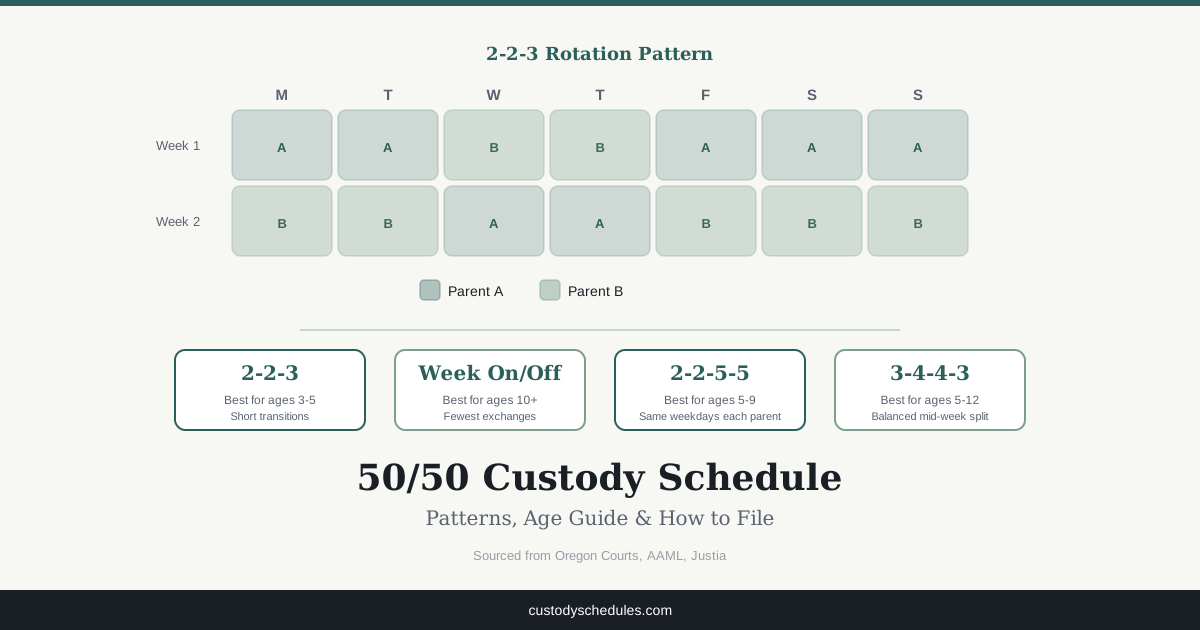
One exchange per week. Your child spends Monday through Sunday with you, then the same block with your co-parent.
It's the simplest 50/50 custody schedule operationally — one handoff per week, clear boundaries, and enough time in each home to settle into a routine. Oregon Judicial Department age-based parenting plan schedules include alternating-week arrangements specifically for school-age children and teens. The catch: seven days is a long stretch for a toddler or preschooler who still needs frequent contact with both parents.
2-2-3 Schedule
Two days with you, two days with your co-parent, three days back with you — then the pattern flips the following week. No parent goes more than three consecutive days without seeing the child. That constraint is what makes the 2-2-3 custody schedule the go-to recommendation for toddlers and preschoolers.
On paper the rotation looks confusing. In practice, it becomes second nature fast. One parent on r/Custody put it well: "It sounds complicated until you've lived it for two weeks — then you stop thinking about the schedule and just think about the days." (Shared with permission, paraphrased to protect privacy.) The biggest practical downside is for parents with irregular work schedules, where predicting "which days are mine" three months out gets genuinely difficult.
2-2-5-5 Schedule
Here the mid-week exchange stays fixed — your child always knows where they're sleeping Wednesday night. The pattern: two days with you, two days with your co-parent, then five days with you, five days with your co-parent.
The 2-2-5-5 custody schedule suits preschoolers who are developmentally ready for slightly longer stretches but still benefit from that mid-week touchpoint. It also works well for parents who have fixed weekday schedules and need a predictable mid-week handoff they can plan around. What it doesn't handle well is distance — if the two homes are more than 20-30 minutes apart, that Wednesday exchange starts to feel like a commute.
3-4-4-3 Schedule
Parent A has 3 days, Parent B has 4 days, then Parent B has 3 days, Parent A has 4 days. The switch point rotates through the week, which distributes weekends more evenly than alternating weeks does. Over a two-week cycle, each parent gets roughly the same mix of school days and weekend days — something alternating-week families sometimes argue about when one parent consistently ends up with more Monday mornings.
It's a reasonable middle ground between the 2-2-3 and alternating weeks, but it requires more tracking. Apps like TalkingParents keep a shared calendar that automatically shows each parent's upcoming days — useful when the rotation doesn't follow a simple weekly rhythm.
Schedule Comparison Table
| Pattern | Exchanges/week | Best for | Avoid if |
|---|---|---|---|
| Alternating weeks | 1 | School-age kids, teens, long-distance co-parents | Infants/toddlers; high-conflict co-parents |
| 2-2-3 | 2–3 | Toddlers, preschoolers, frequent-contact families | Parents with unpredictable work schedules |
| 2-2-5-5 | 2 | Preschool to early school-age | Parents who live far apart |
| 3-4-4-3 | 2 | School-age kids; parents who want weekend equity | Families who prefer a fixed weekday routine |
Which Schedule Fits Your Child's Age?
Age matters more than almost any other variable. Courts and child development researchers have published developmental schedules for ages birth through 18, and knowing where your child falls will save you from selecting a pattern that creates more stress than it solves.
Under 3
Young children build attachment through repetition — the same face at bedtime, the same morning routine, night after night. Long stretches away from either parent disrupt that process. For this age group, three-day blocks are typically the maximum experts recommend, which makes 2-2-3 the practical ceiling. Alternating weeks is almost never appropriate before age 3.
That said, "under 3" isn't monolithic. A 6-month-old and a 32-month-old have very different overnight tolerances. If you're navigating this age range, it's worth getting input from a child psychologist before filing — not because you need court permission, but because the research genuinely matters here.
Ages 3–5
Preschoolers can handle slightly longer stretches but still crave predictability over flexibility. A 2-2-3 or 2-2-5-5 custody schedule works well for most kids in this window. Alternating weeks becomes possible toward age 5 — particularly when combined with a mid-week FaceTime call or brief dinner visit to maintain connection with the off-duty parent.
School Age (6–12)
All four patterns work once kids are in school. What actually decides it: how close the two homes are to school, which parent handles morning drop-off, and whether your child has after-school activities that require consistent pickup from the same location. Logistical friction is the enemy of a stable 50/50 schedule at this age.
Many families at this stage use OurFamilyWizard to track exchanges — the app logs every schedule change with timestamps, which matters if disputes arise later. Alternating weeks tends to win at this age simply because fewer transitions mean fewer forgotten backpacks.
Teens
By 13 or 14, your child has their own calendar — sports, jobs, social plans that don't fit neatly into a two-week rotation. Alternating weeks gives them a stable home base without constant switching. Most parenting plans for teens include a clause giving them input on the schedule, and courts in most states formally weigh an older child's preference. One parent on r/Divorce noted: "Our 16-year-old basically set his own schedule. The judge asked what he wanted and went with it almost exactly." (Paraphrased from a public thread; identifying details omitted.)
Pros and Cons of 50/50 Parenting Time
Equal time isn't automatically better — it's better when the conditions support it.
| Pros | Cons |
|---|---|
| Both parents stay deeply involved in the child's daily life | Requires sustained co-parent communication |
| Children maintain strong bonds with both parents | More transitions can be disruptive for some children |
| Reduces the "every-other-weekend" resentment dynamic | Logistics get complex when parents live far apart |
| Neither parent carries the full burden of solo parenting | Child's belongings may need to be duplicated across two homes |
| Often reduces conflict over parenting time disputes long-term | Scheduling holidays and activities takes more upfront planning |
Equal time works best when both parents live close enough to share a school district and can communicate without escalating. If geography or ongoing conflict makes 50/50 impractical day-to-day, a 60/40 custody schedule can reduce friction while still keeping both parents genuinely involved. For situations where one parent travels frequently or lives in a different school district, a 70/30 schedule or 80/20 arrangementcan still protect meaningful parenting time without forcing a logistical arrangement that doesn't hold up.
How 50/50 Custody Works in Your State
State law shapes what courts do with your parenting plan — and the differences between states are real enough to matter.
States with a 50/50 presumption— Kentucky, Arkansas, and West Virginia — have passed laws establishing equal parenting time as the legal starting point. Courts in these states begin from the assumption that 50/50 serves the child's best interest; a parent who wants something different bears the burden of proving otherwise.
Arizona and Floridarequire courts to maximize each parent's time. That doesn't guarantee exactly 50/50, but it creates strong institutional momentum toward equal or near-equal splits. Judges in these states are expected to justify deviations from maximum parenting time in writing.
Most other states— California, Texas, New York, and the majority — use a best-interests analysis without any presumption. Courts weigh work schedules, school proximity, sibling relationships, and each parent's history of involvement. A 50/50 schedule is absolutely achievable in these states. It just isn't presumed. Where you live shapes what you can realistically expect without a fight.
Review your state's specific statutes before drafting a parenting plan — what's automatic in Kentucky may require a full evidentiary hearing in New York.
Handling Holidays, School Breaks, and Summers
Regular weeks run on autopilot once you're in a rhythm. Holidays are where things break down — and if your parenting plan doesn't spell out exactly who has the kids on Thanksgiving, you'll be texting about it every November.
The standard approach is an even/odd year alternating model: in odd years, Parent A gets Thanksgiving and Parent B gets the first half of winter break; in even years, the assignments flip. Birthdays, Mother's Day, and Father's Day go to the respective parent every year without rotation. Spring break and summer are typically split in half or rotated annually.
Two details most plans get wrong:
- Holiday provisions should override the base schedule. When a holiday falls during your co-parent's regular week, the holiday schedule takes over for that window only — then the base schedule resumes as if the holiday didn't interrupt it.
- Define exact hours, not just days.Not "Christmas" — write "December 24 at 6 PM through December 26 at 10 AM." Vague language is the most common source of holiday disputes.
Summer logistics are their own project. Many families shift to longer two- or three-week blocks to accommodate travel, camps, and family visits. Lock down the summer schedule by April 1 each year — anything later and you're competing with other families for camp slots and flight prices.
A shared co-parenting calendar makes it much easier to track holiday overrides stacked on top of your base schedule — especially once school-year activities and sports seasons enter the picture.
How to Make a 50/50 Schedule Official
Agreeing with your co-parent is the easy part. A 50/50 schedule only protects both of you when it's in writing and signed by a judge.
- Build the calendar first. Use our free custody schedule generator to map out the full year visually. Seeing 12 months of actual dates — not just the abstract pattern — surfaces conflicts that aren't obvious until you're looking at them.
- Write a parenting plan. The schedule is one section. The full parenting plan template also covers holiday rotations, decision-making rules, communication protocols, and a dispute resolution process. Courts expect all of it.
- File with the court. In most states you submit the parenting plan as part of your divorce or custody filing. Modifying an existing order requires a motion to modify. Both parents typically sign before submission.
- Attend the hearing if required. Uncontested plans are often approved on the papers alone. Contested plans go to a hearing where the judge decides.
- Get certified copies of the order. Share them with schools, coaches, and childcare providers — anyone who needs to know which parent is responsible on which days.
Start by building your schedule visually. Generate a printable custody calendar you can bring to your first co-parent conversation — or to your attorney.
Related Reading
- 2-2-3 custody schedule — the most popular 50/50 rotation for toddlers and preschoolers
- 2-2-5-5 custody schedule — fixed mid-week exchange with alternating five-day blocks
- 60/40 custody schedule — when equal time doesn't match your work or geography
- parenting plan template — the 9 sections every court expects to see
- co-parenting schedule guide — all 7 common arrangements compared side by side