Picture this: your 3-year-old is clinging to your leg at drop-off, crying because he doesn't understand why he won't see Daddy until next weekend. Five days feels like forever when you're barely old enough to count to ten.
That scene is exactly why the 2-2-3 custody schedule exists. Instead of sending a young child away for a full week, it caps the longest stretch at three days. Both parents stay in the picture all week, every week — no one becomes the "weekend visitor."
Below, you'll find the full rotation laid out day by day, a printable two-week calendar, and a clear breakdown of which ages this schedule fits best — plus what to do when your child outgrows it.
What Is a 2-2-3 Custody Schedule?
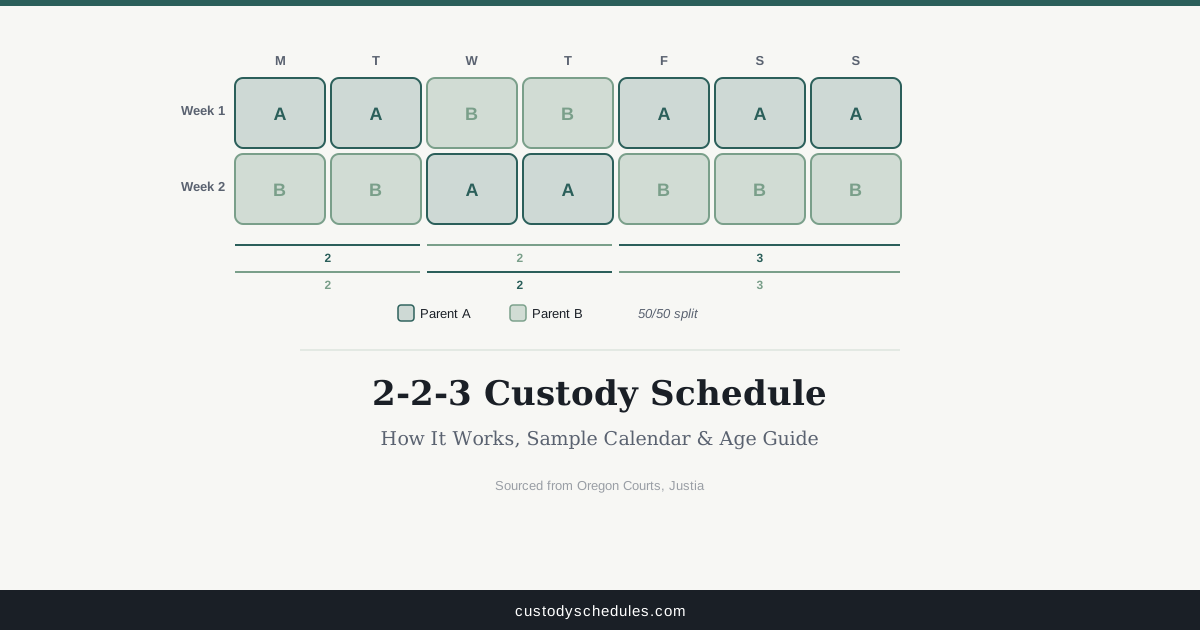
A 2-2-3 custody schedule is a 50/50 custody schedule that splits each two-week period into three blocks: two days with one parent, two days with the other, then three days back with the first. The following week, the pattern flips — so each parent gets the three-day weekend block every other week.
Over a full two-week cycle, each parent logs exactly 7 overnights. That's 182.5 per year, per parent. No rounding errors. No "primary" parent.
The name comes from the block lengths: 2 days, 2 days, 3 days. Some family law attorneys call it a "rotating 2-2-3" because the weekend parent alternates. Courts in California list it among shared custody arrangements available to parents seeking equal parenting time.
How the 2-2-3 Rotation Works
Forget abstract descriptions — here are the actual days.
Week 1:
- Monday & Tuesday — your child is with Parent A
- Wednesday & Thursday — your child is with Parent B
- Friday, Saturday & Sunday — your child is with Parent A
Week 2 (the flip):
- Monday & Tuesday — your child is with Parent B
- Wednesday & Thursday — your child is with Parent A
- Friday, Saturday & Sunday — your child is with Parent B
Then Week 1 repeats. Each parent always has the same two weekdays — Parent A gets Monday-Tuesday every week, Parent B gets Wednesday-Thursday every week — and the three-day weekend block alternates. That consistency is the real advantage: your child always knows which parent picks them up on Monday and which one has Wednesday. The only variable is who gets the long weekend.
Sample 2-Week Calendar
Here's what two full weeks look like, day by day. "A" marks Parent A's days, "B" marks Parent B's days.
| Week | Mon | Tue | Wed | Thu | Fri | Sat | Sun |
|---|---|---|---|---|---|---|---|
| Week 1 | A | A | B | B | A | A | A |
| Week 2 | B | B | A | A | B | B | B |
Count the letters: Parent A has 7 overnights across the two weeks (Mon, Tue, Fri, Sat, Sun in Week 1 plus Wed, Thu in Week 2). Parent B has 7. Perfectly equal.
Want to map this onto your actual calendar with specific dates? Our free custody schedule generator lets you plug in your start date and prints the rotation for the next 12 months.
Best Ages for the 2-2-3 Schedule
The 2-2-3 is built for young children — specifically toddlers and preschoolers roughly 18 months to 5 years old. Their sense of time is undeveloped. Three days already feels like a stretch. A full week away can trigger anxiety, regression, and bedtime meltdowns that have nothing to do with the other parent and everything to do with developmental stage.
The Oregon Judicial Department's parenting plan guide organizes schedule recommendations by developmental stage, emphasizing that children under 3 need shorter, more frequent contact with both parents. The 2-2-3 fits squarely within those guidelines.
For school-age children (6 and up), the schedule still works but starts competing with simpler alternatives. As Justia's custody schedule overview notes, older children can handle longer blocks, and the mid-week exchanges can clash with homework routines and after-school activities. Many families shift to a 2-2-5-5 custody schedule or alternating weeks around first grade.
One parent on r/Custody described the transition this way: "We used 2-2-3 from age 2 to about 5. Our daughter thrived because she never went more than two days without seeing either of us. Once kindergarten started, we switched to week-on-week-off and she adjusted fine — she was just older and could hold onto the time differently."
Pros and Cons of the 2-2-3 Custody Plan
No custody schedule is perfect — the 2-2-3 included. Here's an honest look at both sides.
What works well
- Short separations. Your child never goes more than 3 days without seeing either parent — critical for toddlers building attachment with both of you.
- True 50/50 split.Neither parent is the "primary" and neither is the "visitor." Both of you get weekdays and weekends.
- Predictable weekday routine. Parent A always has Monday-Tuesday. Parent B always has Wednesday-Thursday. Daycare providers and grandparents can plan around fixed days without checking a rotating calendar.
- Weekend equity. Each parent gets the three-day weekend every other week — no one is stuck with only school nights.
- Easier early adjustment. For families fresh out of a separation, frequent exchanges ease children into the two-home reality without a jarring week-long absence from either parent.
What to watch out for
- Lots of transitions. Two to three exchanges per week means more packing, more handoffs, and more chances for miscommunication about who brings the soccer cleats.
- Proximity matters more here than in most schedules. If you and your co-parent live more than 15-20 minutes apart, the mid-week drives add up fast — especially on school mornings.
- Not ideal for high-conflict co-parents. More exchanges mean more face-to-face contact. If handoffs tend to escalate, consider curbside drop-offs or using school as the exchange point.
- Travel and work schedules. Parents with unpredictable hours or frequent business travel may find the rigid rotation hard to maintain. A 60/40 custody schedule offers more flexibility for uneven work demands.
2-2-3 vs. Alternating Weeks: Which Should You Pick?
Both schedules split time 50/50. The difference is rhythm — and age is usually the deciding factor.
| Factor | 2-2-3 | Alternating Weeks |
|---|---|---|
| Longest stretch away from one parent | 3 days | 7 days |
| Exchanges per week | 2-3 | 1 |
| Best age range | Toddlers through age 5-6 | School-age (6+) through teens |
| Weekday consistency | High — same weekdays every week | Low — weekdays alternate |
| Packing & logistics | More frequent, lighter loads | Less frequent, bigger hauls |
| Co-parent communication load | Higher | Lower |
A dad on r/Custody put it bluntly: "Alternating weeks felt like an eternity when my son was 3. We switched to 2-2-3 and the crying at drop-off stopped within two weeks. Now he's 7 and we're back on week-on-week-off — he actually prefers settling in for longer stretches."
If your child is between 4 and 6, also consider the 2-2-5 custody schedule or 2-2-5-5 custody schedule as middle-ground options that reduce exchanges while still keeping separations shorter than a full week.
Making the 2-2-3 Work Long-Term
The rotation itself is simple. Sticking to it month after month takes a system.
A shared calendar app is non-negotiable. OurFamilyWizard is built specifically for co-parents — it tracks the rotation, logs exchanges, and keeps a timestamped communication record that's admissible in court if disputes arise. For lower-conflict families who just need a visual calendar both parents can access, Cozi works fine and costs nothing.
One habit that saves enormous headaches: pack a "go bag" that lives in your car. Toothbrush, pajamas, a comfort toy — duplicates of the essentials so your child doesn't need a suitcase for a two-day stay. The logistics get lighter when you stop treating every exchange like a move.
Exchanges should be boring. Same time, same place, same quick goodbye. A 30-second hug and a cheerful "see you Wednesday!" teaches your child that transitions are normal — long emotional farewells backfire with toddlers, who mirror your anxiety directly. Did your child skip their nap or catch a cold? Send a two-line text at handoff, not a paragraph. The receiving parent just needs enough context to carry on.
Finally, build in a review date. The 2-2-3 isn't meant to last forever. Write a clause into your parenting plan template that triggers a schedule review when your child starts kindergarten, or at any milestone you both agree on. Planning the transition in advance prevents a fight about it later.
How to File a 2-2-3 Parenting Plan
A handshake agreement won't protect either parent when conflicts arise. You need the schedule in writing, approved by a judge.
- Map out the calendar. Use our custody schedule generator to print 12 months of your 2-2-3 rotation with actual dates. Bring it to your co-parent meeting — seeing the days on paper surfaces conflicts you won't catch in conversation.
- Draft a parenting plan. The plan covers more than the weekly rotation: holiday schedules, vacation time, decision-making authority, communication rules, and a process for resolving disagreements. Courts in most states have standardized parenting plan forms you can download. Our parenting plan template walks you through every section.
- Both parents sign.An agreed-upon plan moves faster through the court system. If you can't agree, the court will likely order mediation before scheduling a hearing.
- File with your county family court. Submit the signed plan as part of your divorce or custody petition. Modifying an existing order? File a motion to modify custody and attach the new schedule.
- Attend the hearing.Uncontested plans are often approved the same day. If the judge has questions about a young child's age or the exchange frequency, be ready to explain why the 2-2-3 pattern serves your child's developmental needs.
- Receive your court order. Once signed by the judge, the parenting plan is legally binding. Share a copy with daycare providers, schools, and anyone else who needs to know the arrangement.