You work Tuesday through Saturday. Your ex works a standard Monday-Friday job. When you first separated, you tried making a 50/50 custody schedulework — but your daughter kept missing Saturday morning soccer because the handoff timing never lined up. After two months of scrambling, you realized the problem wasn't effort. It was math.
A 60/40 custody schedule would have solved that from day one.
This guide walks you through the three most common 60/40 patterns, when each one fits, how the split affects child support, and exactly how to propose your schedule to a judge if your co-parent doesn't agree.
What Is a 60/40 Custody Schedule?
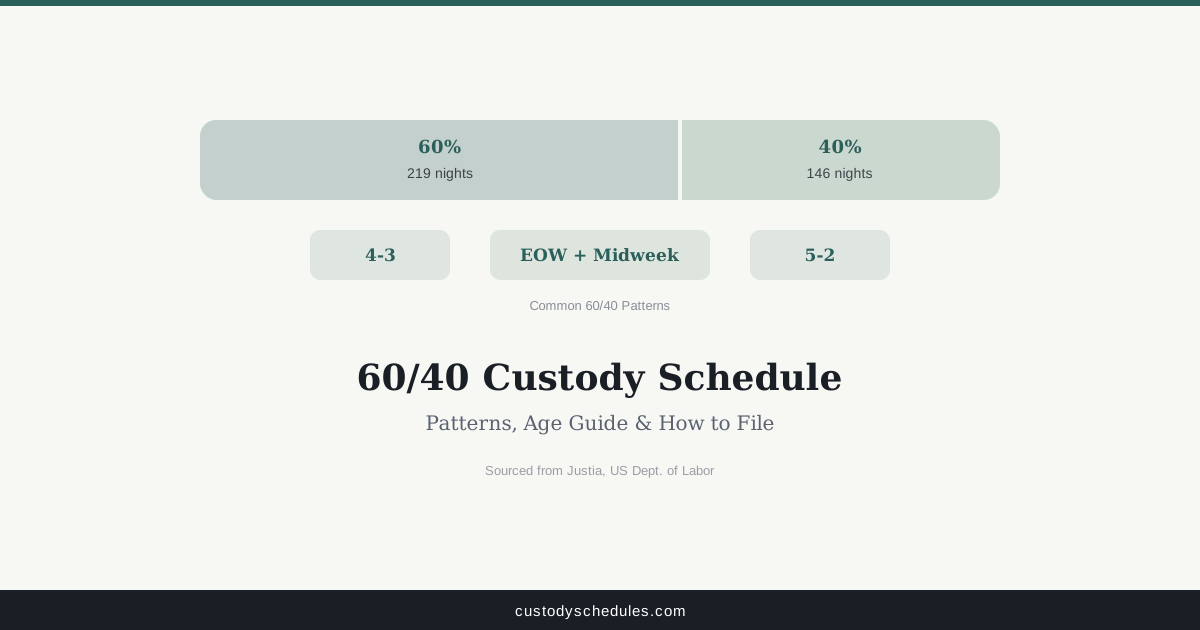
A 60/40 custody schedule gives one parent roughly 60% of overnights and the other parent 40%. In a full year, that breaks down to about 219 overnights for the primary parent and 146 for the other.
That split is not a demotion. Courts in every US state use the best-interest-of-the-child standard to guide custody decisions, and for many families, 60/40 serves children better than forcing a symmetric schedule onto real-life logistics that don't fit it.
One parent on r/Custody described the shift this way: "We stopped arguing over equal days and started asking which days actually worked for our son's school pickup. Once we reframed it that way, the disagreement pretty much dissolved." That's not unusual. Families that anchor the conversation around the child's routine rather than parental fairness tend to reach agreement faster.
The 60/40 label describes time, not authority. You can share legal custody — all major decisions about school, healthcare, and religion — even when physical custody is split 60/40.
Common 60/40 Schedule Patterns
No single template fits every family. Below are the three most widely used 60/40 arrangements, each with a different trade-off between simplicity and flexibility. If you're also considering how to structure specific days within a rotation, the 2-2-3 custody schedule breaks down a popular alternating-day approach that some parents combine with 60/40 principles.
4-3 Schedule
One parent has the child Monday through Thursday; the other takes Friday through Sunday. Same pattern every week — no alternating, no guesswork. Your child always knows which home they're waking up in.
The limitation is structural: Parent A permanently holds weekdays, Parent B permanently holds weekends. That imbalance breeds resentment faster than most families expect — the weekday parent handles homework and sick days while the weekend parent gets birthday parties and outings. If that becomes a friction point, consider building in a monthly Saturday swap or rotating to the alternating-weekend variation below.
Every-Other-Weekend Plus Midweek Overnight
The secondary parent gets every other weekend (Friday evening to Sunday evening) plus one midweek overnight — typically Wednesday. Over a two-week cycle, that adds up to about 6 overnights out of 14, landing close to 43% — effectively 60/40.
This works well for school-age children with established weekday routines, especially when the two homes are far enough apart that frequent transitions would mean long drives. One thing to watch: a Wednesday overnight can feel disruptive for kids under 6 who are still building security in their primary home. Some families swap it for a Thursday pickup, turning it into a long weekend every other week without the mid-week interruption.
5-2 With Alternating Weekends
The primary parent has the child Monday through Friday. The secondary parent takes weekends — but every other week, the primary parent keeps the weekend too. Averaged over two weeks, the split lands at roughly 60/40.
This structure suits families where uninterrupted school-week consistency is the top priority. It also works well when the non-primary parent travels for work and prefers reliable block-schedule weekends over scattered overnights mid-week. Confirm both work calendars first: a parent working weekend shifts will find this impossible to maintain, and last-minute swaps quickly undermine the routine.
Schedule Comparison Table
| Pattern | Primary Overnights (2-wk) | Non-Primary Overnights | Best For |
|---|---|---|---|
| 4-3 schedule | 8 | 6 | Simplicity, consistent weekly routine |
| EOW + midweek overnight | 8 | 6 | Older school-age kids, distant parents |
| 5-2 alternating weekends | ~8.5 avg | ~5.5 avg | Strong school-week structure |
Test any of these patterns and print a court-ready calendar using our free custody schedule generator.
60/40 vs. 50/50 — How to Decide
Most states start from a presumption that equal time is in the child's best interest. But equal time and best time are not always the same thing.
Five situations where 60/40 tends to serve children better than a 50/50 custody schedule:
- Long commute or frequent work travel.If you're regularly away Monday through Thursday, a 60/40 schedule that matches your actual availability is more realistic than a 50/50 arrangement that demands constant last-minute swaps.
- Young children who need a consistent home base. Research on attachment suggests that infants and toddlers benefit from a primary caregiver during the early years while still maintaining regular contact with the other parent.
- Geographic distance. When the two homes are 30–45+ minutes apart, frequent school-week transitions in a 50/50 schedule create commute fatigue for your child. A 60/40 school-week block minimizes that.
- High-conflict co-parenting. Fewer transitions mean fewer handoff opportunities for conflict. A 60/40 schedule can reduce friction during the early post-separation period while both parents stabilize.
- One parent's honest preference.Courts do consider a parent's expressed preference, especially when backed by practical reasoning. If you genuinely prefer a reduced schedule during a demanding career phase, 60/40 reflects that honestly.
If you're weighing a more primary-focused split, the 70/30 custody schedule shows what shifts when one parent takes a larger share. And for arrangements where one parent has the child most of the time, the 80/20 custody schedule breakdown covers how those orders typically get structured.
How a 60/40 Schedule Affects Child Support
Overnight count drives the math. In most states, the parent with 40% of overnights pays child support to the parent with 60%. The logic is straightforward: the parent housing the child 219 nights per year carries proportionally higher costs for food, utilities, and daily care.
Exact formulas vary by state. California and Colorado use an income-shares model that heavily weights overnight percentage. Other states apply a flat formula adjusted when overnights fall above or below a threshold. The US Department of Labor maintains resources on child support enforcement across states, and most state courts publish their own worksheet calculators you can run before consulting an attorney.
Three practical points worth keeping in mind:
- Child support amounts are set when the order is signed and do not automatically adjust when you informally change the schedule. If you modify the parenting plan, file for a formal modification so support reflects the new arrangement.
- When both parents earn similar incomes under a 60/40 split, the support obligation may be modest — because both parents are already covering roughly proportional costs.
- Always run your numbers through your state's child support guidelines worksheet or consult a family law attorney before assuming what the amount will be.
Age Considerations for a 60/40 Schedule
A schedule that works for a 3-year-old will probably need an overhaul by age 10. Plan for it.
For infants and toddlers, attachment to a primary caregiver is the developmental priority. Most frameworks suggest the primary parent hold the majority of overnights, with the other parent seeing the child every few days in shorter blocks. A 60/40 split fits naturally here — though some attachment-focused approaches recommend more daytime contact for the non-primary parent rather than long overnight stretches in the first year.
Preschoolers (ages 3–5) can handle more overnights away from the primary home, but predictability still matters enormously. The every-other-weekend plus midweek overnight pattern tends to work well at this stage because it provides regular contact without disorienting their sense of home base.
Once school starts, the calendar becomes the dominant constraint. Homework and morning routines don't survive chaotic mid-week handoffs well. The 4-3 or 5-2 pattern — both keeping school-week days with one consistent parent — tends to fit here, and schools generally appreciate knowing which parent to call on which days.
By the teen years, your child increasingly wants a say in where they sleep. Most courts will consider their preferences by mid-adolescence. A 60/40 order set when your child was 8 may naturally drift toward 50/50 as they get more mobile. Build in an annual review so you can adjust without going back to court every time circumstances shift.
How to Propose a 60/40 Schedule to the Court
If you and your co-parent can't agree, you'll present a parenting plan to a judge. Courts don't reject 60/40 outright — but you need to show the schedule serves your child, not just your calendar.
- Document your rationale with specifics.Write down concrete reasons 60/40 fits your family: your work schedule with hours and location, distance between homes, your child's current routine, any special needs. A judge who sees "I work Tues–Sat, 7am–4pm, 22 miles from the school" takes that more seriously than "my schedule is demanding."
- Draft a detailed parenting plan. Vague proposals lose in court. Specify exact pickup and drop-off times, school-year schedule, summer schedule, and how holidays rotate. Our parenting plan template gives you a starting framework you can customize for your state.
- Include a holiday and vacation rotation.Courts want to see that both parents get meaningful holiday time. Your 60/40 base schedule doesn't mean the non-primary parent misses every Thanksgiving — propose a fair holiday rotation separately from the regular schedule.
- Address parent-to-parent communication.Spell out how you'll handle schedule changes, school emergencies, and medical decisions. Courts look favorably on plans that reduce future litigation.
- File with your county family court. Requirements vary by state, but most require a proposed parenting plan with the initial filing. Some states mandate mediation before a judge will hear contested custody. Check your local court's filing requirements.
- Propose a built-in review date.Suggesting an annual review — or one tied to a school transition — signals to the court that you're thinking about your child's changing needs, not just locking in a favorable order.
Ready to build the actual schedule? Build your 60/40 custody schedule with our generator, then export a PDF you can attach directly to your court filing.
Making a 60/40 Schedule Work Long-Term
Getting the order signed is the easy part. Sustaining a 60/40 schedule across school years, remarriages, job changes, and adolescence takes more than a calendar.
The single biggest operational upgrade most families make: OurFamilyWizard. It keeps a timestamped message log that holds up in court if disputes arise — and some courts actually require it for high-conflict cases. TalkingParents offers a similar record with a slightly simpler interface. If your previous co-parenting app shut down (looking at you, AppClose), see our AppClose alternatives roundup for a current comparison. Even in low-conflict situations, a shared digital calendar prevents "I didn't know about that" moments that quietly erode trust over time.
One thing many parents learn the hard way: informal flexibility can backfire legally. If you regularly let the other parent take extra time without documenting it, that pattern can be cited as evidence of a de facto schedule change — and used in a modification motion against you. Want to be generous? Put it in writing. A quick message in OurFamilyWizard saying "one-time swap for [date], not a schedule change" takes ten seconds and protects you both.
Schedule an annual review. Pick a fixed date each year — your child's birthday or the start of the school year — and sit down with your co-parent (bring a mediator if needed) to ask whether the arrangement is still working. A planned review feels far less adversarial than a crisis-driven modification filing. And if child support is tied to overnight percentage, keep a simple log. The calendar in our custody schedule generator produces that record automatically.
Related Reading
- 50/50 custody schedule — four equal-time patterns compared side by side
- 70/30 custody schedule — what changes when one parent takes a larger share
- 2-2-3 custody schedule — a common alternating rotation some parents combine with 60/40 principles
- parenting plan template — how to put your custody schedule into a court-ready document