You're stationed three hours from your kids. Every other Friday, you drive up, pick them up from school, and have them until Sunday evening. Twice a month you squeeze in a Wednesday dinner. One night you do the math: 73 overnights out of 365.
That's 20% of their childhood, and the number lands hard.
But an 80/20 custody schedule isn't a verdict on who the better parent is. It's a structure shaped by geography, work demands, military deployment, or a court order you didn't choose. If you're living it — or figuring out whether it fits your family — this guide covers the patterns, the overnight math, the child support implications, and a realistic path toward more time if that's where you want to go.
What Is an 80/20 Custody Schedule?
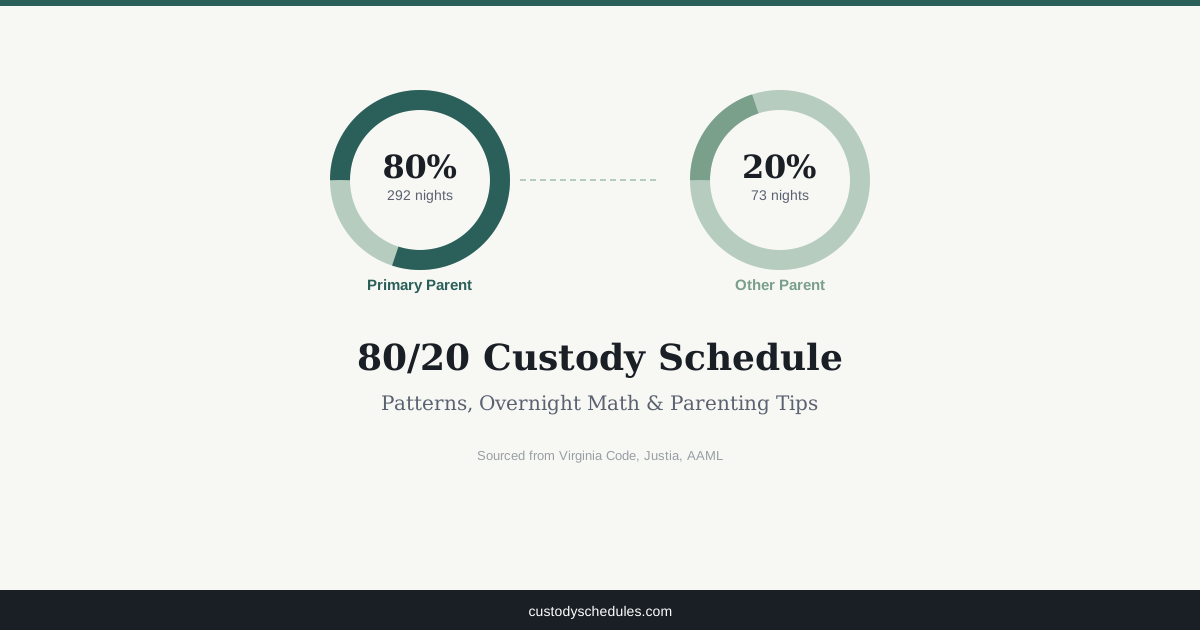
An 80/20 custody schedule means one parent has the child for roughly 80% of overnights per year — about 292 nights — and the other parent has the remaining 20%, or about 73 nights. In most states, this falls under sole physical custody with visitation rights rather than joint physical custody, though both parents can still share joint legal custody over decisions about school, medical care, and religion.
Courts don't hand down 80/20 as a default. The best-interest-of-the-child standard guides every custody decision in every US state, and judges weigh factors like each parent's living situation, work schedule, proximity to the child's school, and the child's own preferences (for older kids) before arriving at any particular split. The result is often 80/20 not because anyone chose it deliberately, but because it's what the circumstances added up to.
One pattern comes up often on r/Custody: parents discover they're in an 80/20 arrangement only after actually counting overnights. What they've been calling "regular visitation" turns out to be exactly this split — a reminder that labels matter less than the numbers in your parenting plan.
Common 80/20 Schedule Patterns
How do 73 overnights play out across the year? There are three main configurations, and the right one depends on how far apart you live, what your work schedule looks like, and how old your child is.
Every Other Weekend + Midweek Dinner
The non-custodial parent picks the child up Friday after school and returns them Sunday evening, every other week. A Wednesday evening visit — dinner from 5 PM to 8 PM, no overnight — keeps contact consistent between those weekends. Some families convert that Wednesday to an overnight, which nudges the actual split to roughly 75/25.
Over a two-week cycle, this gives the non-custodial parent 4 overnights out of 14. It works well when you live within an hour of each other, and school-age children adapt easily because the school-week routine stays anchored to one home. The predictability helps kids know what's coming without needing to track a complicated calendar.
Every Other Weekend Only (No Midweek)
When distance makes midweek visits impractical — say you're two or three hours away — the schedule simplifies to every other weekend, Friday to Sunday. That's roughly 52 overnights per year, technically closer to 85/15 than 80/20. To reach a true 80/20, parents typically add a fifth weekend per quarter, extend stays to include Monday morning school drop-off, or build extra overnights into school holiday weeks.
Modified Summer Schedule
During the school year, the non-custodial parent follows a basic every-other-weekend pattern. Come summer, the arrangement flips: the child spends three to four consecutive weeks with the non-custodial parent. Depending on the exact breakdown, the full-year total lands between 73 and 80 overnights. This approach is especially common for long-distance families and military parents, because a concentrated block of time lets your child actually settle in rather than living out of a weekend bag.
Overnight Math: How the Numbers Actually Work
Child support formulas and custody classifications depend on exact overnight counts — not rough estimates. Here's how the three main 80/20 patterns compare over a full year.
| Pattern | Non-Custodial Overnights/Year | Actual Split | Notes |
|---|---|---|---|
| EOW (Fri–Sun) only | 52 | ~85/15 | Add holiday time to reach 80/20 |
| EOW + Wed overnight | 78 | ~79/21 | Closest to true 80/20 |
| EOW + 4-week summer block | 80 | ~78/22 | Common for long-distance families |
| EOW (Fri–Mon) extended | 78 | ~79/21 | Requires Monday school drop-off |
Why does precision matter? In states like Arizona, child support adjustments kick in at specific overnight thresholds. The difference between 70 and 80 overnights can shift your monthly obligation by hundreds of dollars.
Apps like CustodyXChange let you plug in your specific pattern and generate an exact overnight count — useful when you need to present hard numbers to a judge or mediator. OurFamilyWizard serves a similar purpose: beyond tracking overnights, it logs all parent-to-parent communication and expense records in a court-admissible format, which matters if you ever dispute what the schedule actually looked like in practice.
How an 80/20 Schedule Affects Child Support
In most states, the parent with fewer overnights pays child support to the custodial parent. With an 80/20 split, that obligation almost always falls on the 20% parent. The amount depends on three variables: both parents' gross incomes, the number of overnights, and your state's formula.
States handle the math differently. Oklahoma, for instance, provides a parenting time adjustment only when the non-custodial parent has at least 121 overnights per year. At 73 overnights, you won't hit that threshold, so the standard formula applies without any parenting time credit. California and Colorado use an income-shares model that weights overnight percentages more granularly — even the difference between 70 and 80 overnights changes the calculation there. The California Courts self-help guide walks through the basics of how custody and support interact.
Three things worth knowing before you make any assumptions:
- Child support is calculated at the time of the court order, not informally adjusted when the schedule shifts. If your parenting time increases, file a modification so your support obligation reflects the new reality.
- High earners with an 80/20 split can face substantial support obligations — run your state's online child support calculator before deciding anything.
- Never reduce your payments unilaterally because you took extra overnights. Courts treat unpaid support as arrears regardless of your reasoning. Consult a family law attorney before changing anything.
When Does an 80/20 Custody Schedule Make Sense?
Nobody picks 80/20 because they want less time with their children. Parents living this schedule usually arrived here through circumstances, not preference — and that context matters both for your own peace of mind and for how you present the arrangement to a court.
Geographic distance is the most common driver. When two homes are 90+ minutes apart, frequent mid-week transitions become impractical during the school year — so all the contact gets compressed into weekends. Work schedule is a close second: shift workers, medical residents, long-haul truckers, and active-duty military often can't guarantee weeknight availability. An 80/20 schedule built around actual availability is more stable for a child than a 50/50 plan that quietly falls apart every other week.
Age matters too. Some attachment-focused parenting frameworks suggest that infants and toddlers benefit from one primary home base, with the other parent present in shorter, more frequent blocks. An 80/20 pattern during the first two years — transitioning toward a 70/30 custody schedule or a 60/40 custody schedule as the child grows — is a common trajectory, not a permanent sentence.
Courts may also set 80/20 as a starting point after a parent has been rebuilding stability: completing rehab, resolving a housing situation, returning from extended absence. A commenter on r/Divorce put it plainly: "The judge didn't take my kids away — he gave me a roadmap to get back to 50/50. The 80/20 was the starting line, not the finish line." That framing is worth holding onto if you're in a similar position.
Finally, older children and teenagers sometimes choose a primary home themselves — staying close to friends, a school, or extracurriculars they don't want to leave. Courts in most states weigh the child's preference once they reach a certain age, often 12 or 14 depending on the jurisdiction.
Research on non-residential parents consistently shows that active, engaged parenting during the 20% predicts better child outcomes than passive presence during more time. The quality of your overnights — what you do together, how present you are — matters more than the count.
Transitioning Toward More Parenting Time
An 80/20 schedule doesn't have to be permanent. If your circumstances change — you move closer, your work stabilizes, your child gets older — you can petition for a modification. The path forward usually runs through documentation first.
Start by building a record. Use a co-parenting app to log every exchange, overnight, and extra visit with timestamps. Courts respond to concrete evidence — not "I've been showing up more" but a printout showing 14 additional overnights over the past six months. Keep that log for at least three to six months before filing anything. At the same time, identify what's actually changed in your circumstances, because courts require a "substantial change" to modify custody. You relocated within 30 minutes of the child's school. You completed a treatment program. You shifted to a daytime work schedule. Vague claims don't get hearings.
When you're ready to file, ask for a specific schedule — not "more time." A defined pattern, like moving from every-other-weekend to a 70/30 custody schedule with Wednesday overnights added, is far more persuasive than an open-ended request. Use our custody schedule generator to build the exact calendar you're requesting and export it as a PDF for your filing.
Judges are more likely to approve gradual increases than dramatic jumps. An 80/20 → 70/30 → 60/40 progression over 12–18 months is less disruptive than going straight to a 50/50 custody schedule. Some states require mediation before scheduling a hearing, so check your county's process early — it can add weeks to the timeline if you're not expecting it.
How to File an 80/20 Parenting Plan
Whether you're the parent requesting 80/20 or the one receiving it, a detailed written plan gives the court confidence you've thought this through.
Start with specifics, not generalities."Every other weekend" is too vague to enforce. Write it out: "Non-custodial parent picks up child at school at 3:15 PM on the first and third Friday of each month. Drop-off at custodial parent's residence by 6:00 PM Sunday." Exact times, exact locations. Include a holiday rotation too — Thanksgiving, winter break, spring break, July 4th — alternating on an odd/even year basis with explicit transition times spelled out.
- Address summer and school breaks.If you're using a modified summer schedule (extended blocks with the non-custodial parent), define the exact weeks and how they interact with summer camps, vacations, and standing commitments.
- Describe your communication plan.How you'll handle schedule changes, emergency pickups, and medical decisions. Courts favor parents who propose low-conflict communication — a shared calendar app, written requests for schedule swaps with 48-hour notice, a defined process for disagreements.
- Add a review clause.Proposing an annual review tied to the child's birthday or school year start signals that you're child-focused and open to adjustment. Judges notice.
File with your county family court. Check your local court's filing requirements for the specific forms and fees — some states accept online filings, others require in-person submission. Our free parenting plan template covers all the sections courts expect to see, including the holiday rotation table and communication protocols.
Related Reading
- 70/30 custody schedule — the most common next step when transitioning from 80/20
- 60/40 custody schedule — how a more balanced split plays out day-to-day
- 50/50 custody schedule — equal-time arrangements and which patterns work best
- parenting plan template — court-ready format covering holidays, school breaks, and communication protocols