You just got a new job with a rotating shift that eats three weeknights. Your co-parent lives ten minutes from school; you live forty. Equal time sounded fair in theory, but your kid would spend half the week in a car.
That's exactly what a 70/30 custody schedule is built for. One parent carries the weekday routine — school drop-offs, homework, bedtime — while the other parent gets concentrated blocks of uninterrupted time on weekends or extended visits. Neither parent disappears from the child's life. The structure just reflects how your family actually lives, not how you wish it could.
One dad on r/Custody put it this way: "I pushed hard for 50/50 because it felt fair to me. But my daughter's school, her friends, her whole life was twenty minutes from her mom's house. The 70/30 wasn't a defeat — it was me finally putting her first." That shift in framing — from fairness to function — is what makes a 70/30 schedule work for the families who choose it.
What Is a 70/30 Custody Schedule?
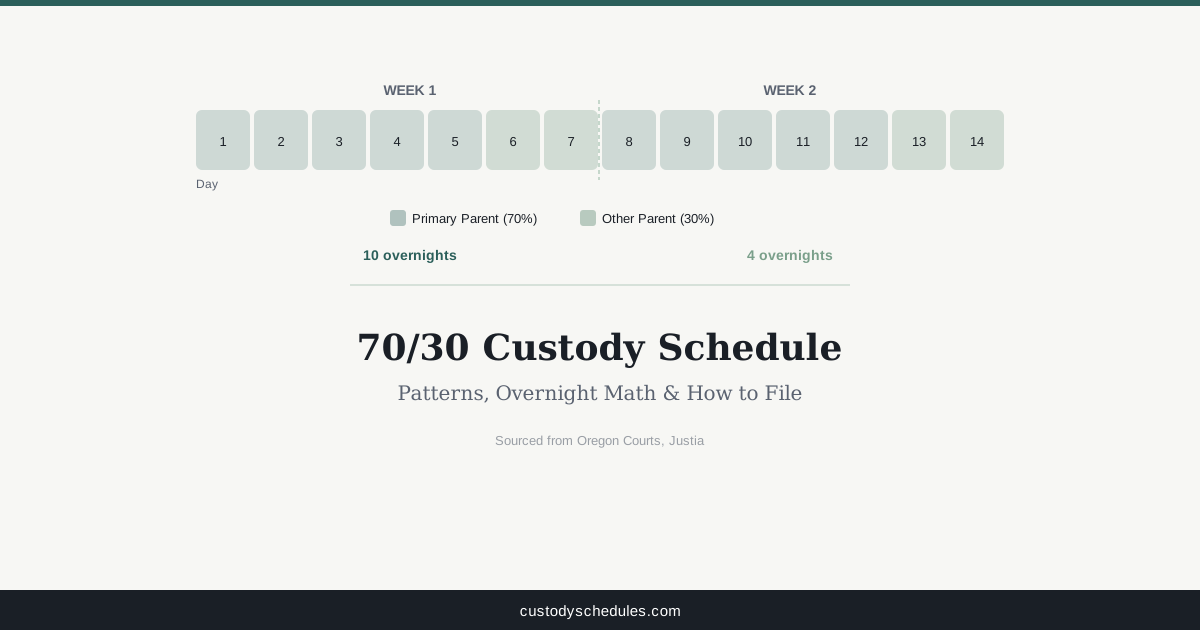
A 70/30 custody schedule gives one parent roughly 70% of overnights and the other parent about 30%. In raw numbers, that's approximately 255 overnights for the primary parent and 110 for the other parent each year.
This is still joint physical custody. The AAML Pennsylvania chapter notes that parents with a 70/30 physical custody schedule usually share legal custody — meaning both parents still make major decisions about education, healthcare, and religion together, regardless of where the child sleeps most nights.
The difference from a 50/50 custody scheduleis practical, not philosophical. One parent just handles more of the daily logistics because geography, work hours, or the child's school make that arrangement more stable for the kid. Both parents stay in the picture.
Three Common 70/30 Patterns
Not every 70/30 parenting time split looks the same. The right pattern depends on your work schedule, how far apart you live, and your child's age. Here are the three arrangements family courts see most often.
Pattern 1: Every Other Weekend + One Midweek Overnight
Parent A has the child Sunday evening through Wednesday after school. Parent B picks up Wednesday after school for an overnight, returns the child Thursday morning, then takes the child again on alternating weekends from Friday evening through Sunday evening.
This is the most common 70/30 custody split for school-age kids — and for good reason. The midweek overnight keeps Parent B connected during the school week instead of waiting a full five days between visits. OurFamilyWizard recommends this pattern specifically because it balances consistency with frequent contact — and their shared calendar makes tracking the rotating weekends simple enough that kids can follow it themselves.
Pattern 2: The 5-2 Fixed Schedule
Parent A has Monday through Friday. Parent B has every Saturday and Sunday. Same days, every single week.
Dead simple. But there's a real cost: Parent B never gets a weeknight, and Parent A never gets a full weekend. Over time, one parent becomes "the homework parent" and the other becomes "the fun parent." Parents on r/Divorce frequently flag this dynamic as a source of slow-burn resentment — especially dads who feel boxed into a weekend-only role while the other parent handles everything that actually matters day to day. The 5-2 works best as a temporary arrangement: a bridge while a younger child adjusts to two homes, or while one parent stabilizes a new work schedule.
Pattern 3: The 4-3 Rotating Schedule
Parent A gets four consecutive days, then Parent B gets three. The start day rotates, so over a two-week cycle both parents experience some weekdays and some weekend time. The natural split lands closer to 57/43, but many families add an extra overnight to Parent A every other cycle to push it toward 70/30.
Pattern Comparison
| Pattern | Parent B overnights/week | Exchanges/week | Works well for |
|---|---|---|---|
| Every other weekend + midweek | ~2.5 (avg) | 2–3 | School-age kids; parents who live close |
| 5-2 fixed | 2 | 2 | Toddlers; parents who need maximum predictability |
| 4-3 rotating | 3 | 2 | Families who want shared weekday and weekend time |
Want to see how these patterns map onto an actual calendar? Build your 70/30 custody schedule visually and download a printable version before your next co-parent conversation.
The Overnight Math: Why Exact Counts Matter
Courts and child support calculators don't care about percentages. They count overnights. Here's how the numbers actually shake out across common 70/30 patterns:
| Schedule type | Primary parent overnights/year | Other parent overnights/year | Actual percentage |
|---|---|---|---|
| Every other weekend + midweek | 256 | 109 | 70/30 |
| 5-2 fixed | 261 | 104 | 71.5/28.5 |
| Every other weekend only (no midweek) | 313 | 52 | 86/14 |
| 60/40 custody schedule | 219 | 146 | 60/40 |
| 50/50 custody schedule | 182 | 183 | 50/50 |
Notice the gap between a 5-2 and an every-other-weekend arrangement without a midweek visit. Dropping that single Wednesday overnight shifts the split from 70/30 all the way to 86/14 — a difference that can change child support calculations by hundreds of dollars per month in states like Colorado and Arizona.
Count your overnights on an actual calendar before you finalize anything. A schedule that "feels like 70/30" might land at 75/25 or 65/35 once holidays are factored in.
Which Ages Fit a 70/30 Split?
Age shapes everything about which 70/30 pattern is realistic — and which one a judge is likely to approve.
Infants and toddlers (0–3) generally need a stable primary home and shorter, more frequent visits with the non-primary parent. The Oregon Judicial Department's parenting plan guide recommends limiting overnight blocks for children under 3, which naturally creates an uneven split. A 5-2 pattern — with the non-primary parent getting two daytime visits plus one overnight — is a common starting point for this age group.
Preschoolers (3–5) can typically handle two consecutive overnights with the non-primary parent. The every-other-weekend plus midweek overnight pattern becomes viable and gives the non-primary parent meaningful time without overwhelming a child who still needs routine.
School-age children (6–12)are where 70/30 is most common and most practical. One parent lives in the school zone; the other doesn't. The child rides the bus from the primary home on weekdays and spends weekends at the other home. Teachers and coaches can actually follow this schedule.
Teenagers (13+)often have strong opinions about where they sleep on school nights — and courts increasingly listen. In California, Texas, and Illinois, a teenager's stated preference carries real weight in custody decisions. A 70/30 arrangement may shift toward a 60/40 custody schedule or a 50/50 custody schedule as a teen becomes more mobile and independent.
How 70/30 Affects Child Support
Almost every state factors in overnight counts when calculating child support. The logic is straightforward: the more overnights you have, the more direct costs you're covering — food, utilities, activities — so your cash obligation drops.
At 110 overnights per year, the non-primary parent in a 70/30 schedule typically crosses the threshold where states begin adjusting the support calculation. Arizona's formula adjusts once a parent exceeds 100 overnights. Colorado's guidelines kick in at 92. The AAML has documented how custody time directly influences support obligations across income-shares states, including Pennsylvania.
Here's the practical math: if you're the non-primary parent with 104 overnights under a strict 5-2, adding a single midweek overnight bumps you to roughly 130 overnights annually. In some states, that shift alone reduces your support obligation by 10–15%.
One caution: courts look unfavorably on parents who request additional overnights purely to reduce support payments. Frame any request for more time around your child's needs, not your budget.
Pros and Cons of a 70/30 Custody Schedule
| Pros | Cons |
|---|---|
| Child has one stable "home base" for school and activities | Non-primary parent misses weeknight moments — homework help, bedtime stories |
| Fewer transitions than a 50/50 custody schedule | Risk of the non-primary parent feeling sidelined over time |
| Works well when parents live in different school districts | Child may start to see one home as "real home" and the other as "visits" |
| Gives the primary parent weekday consistency for routines | Weekend-only parent can slip into "Disneyland parent" mode, skipping discipline |
| Non-primary parent gets uninterrupted quality time on weekends | Harder to shift to 50/50 later without a formal court modification |
One pattern that helps counterbalance the "Disneyland parent" problem: use a tool like TalkingParents to coordinate weeknight involvement even on nights when the child sleeps at the other home — coaching the soccer team, attending Tuesday dinner, showing up to school events. Presence isn't only about overnights. A custody schedule tool can help you map those touchpoints into the written plan so they don't get lost in the shuffle.
How to File a 70/30 Parenting Plan
A handshake agreement won't protect either parent. You need a written parenting plan approved by a judge to make your 70/30 schedule enforceable. The California Courts self-help guide walks through the general process, and most states follow a similar structure:
- Map your schedule on a calendar.Don't describe it in words alone. Use a custody schedule generator to plot every overnight for a full year, including holidays and summer breaks. Bring this to mediation or your attorney meeting.
- Draft a parenting plan. Your plan needs to cover the base schedule, holiday rotations, summer arrangements, communication rules between co-parents, and a dispute resolution process. A free parenting plan template ensures you don't miss required sections.
- Attempt mediation.California, Colorado, and at least 11 other states require parents to try mediation before a custody hearing. Even where it's optional, a mediated agreement is cheaper and faster than litigation.
- File with the family court.Submit your parenting plan with your divorce or custody petition. If you're modifying an existing order, file a motion to modify and attach the proposed new schedule.
- Attend the hearing.If both parents agree on the plan, many courts approve it without a contested hearing. When you disagree, a judge hears both sides and decides based on the child's best interests.
- Get the signed court order.Once approved, it's legally binding. Keep a copy in your car, your phone, and your co-parenting app.
If your co-parent is pushing for equal time but your circumstances don't support it, a 60/40 custody schedule is worth a look — it's the practical middle ground between 70/30 and 50/50 for families where both parents want meaningful involvement but true equal time isn't realistic right now.
Related Reading
- Co-Parenting Schedule Guide — all 7 arrangements compared side by side
- 50/50 Custody Schedule — four equal-time patterns
- 80/20 Custody Schedule — when one parent needs primary time
- Parenting Plan Template — how to put your schedule into a court order