It's 11 PM. You're sitting at the kitchen table with a laptop, a half-cold cup of coffee, and a mediation appointment next Tuesday. Your co-parent already agreed on most of the big stuff — who has the kids during the week, who gets Thanksgiving — but now you need to actually write it all down in a way a judge will approve.
That document is called a parenting plan. Get it right, and you walk out of court with a signed order you can both live with. Leave a section out or keep the language vague, and you'll be back in front of a judge six months from now arguing about what you "meant."
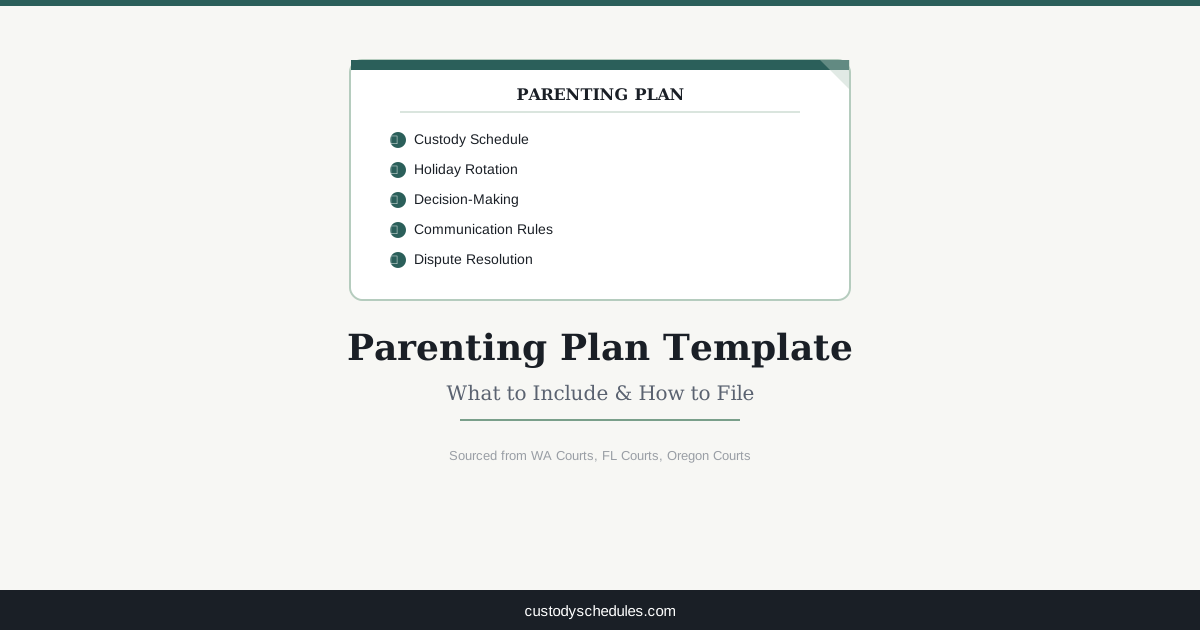
Below is every section your parenting plan needs, how each one looks across different custody splits, and the step-by-step process for filing it with your court.
What Is a Parenting Plan?
A parenting plan is the legal document that turns your verbal custody agreements into a court order. It spells out which parent has the child on which days, who makes decisions about school and healthcare, how you'll handle holidays, and what happens when you disagree.
Once both parents sign and a judge approves it, the plan is legally binding. Violating it can lead to contempt of court proceedings. That can mean fines, modified custody, or worse. Getting the details right the first time saves you from a second trip to the courthouse — and potentially thousands of dollars in attorney fees.
Most states require a parenting plan as part of any custody filing. Washington State's mandatory form covers the residential schedule, dispute resolution, and limitation provisions all in one document — it's among the most comprehensive in the country. Florida, Oregon, and Arizona have similarly thorough requirements.
The 9 Sections Every Parenting Plan Needs
Whether you're working from a state-provided form or building your own, courts expect these nine sections. Skip one, and your plan gets kicked back — or worse, leaves a gap your co-parent exploits later.
1. Custody Schedule (Base Residential Schedule)
This is the backbone of the entire plan. Write exact days and transition times — "every other weekend" won't cut it. "Friday at 6:00 PM through Sunday at 6:00 PM" will.
Still deciding on a pattern? Our free custody schedule generator lets you build and compare rotations visually. Try a 2-2-3 custody schedule for younger kids who do better with frequent transitions, or alternating weeks for school-age children who handle longer stretches.
2. Holiday and Special Day Schedule
Holiday provisions override the base schedule for specific windows. The standard approach is even/odd year alternation: Parent A gets Thanksgiving in odd years, Parent B in even years. Cover every major federal holiday, each parent's birthday, the child's birthday, Mother's Day, Father's Day, spring break, winter break, and any religious observances specific to your family.
The time detail matters more than you think. "Christmas" is ambiguous. "December 24 at 5:00 PM through December 26 at 10:00 AM" is enforceable. Write every holiday that way.
3. School Break and Summer Schedule
Summer often looks nothing like the school year — many families shift to longer blocks, two or three weeks at a time, so kids can do camps and travel. Tie the summer schedule's start and end to the school calendar rather than a fixed date, since school calendars shift year to year. Include a deadline for each parent to submit summer plans (April 1 is typical) and clarify whether the other parent gets contact time during long uninterrupted stretches.
4. Decision-Making Authority (Legal Custody)
Physical custody — where the child sleeps — is a separate question from legal custody, which covers who makes the big calls. Spell out joint or sole authority for each category:
- Education: school enrollment, tutoring, special education
- Healthcare: medical treatment, therapy, dental, vision
- Religious upbringing
- Extracurriculars: sports, music lessons, summer camps
Joint legal custody means both parents must agree — which sounds reasonable until you can't. One parent on r/Custody described it directly: "We spent $4,000 arguing about which school district. Put a tiebreaker clause in the plan and save yourself the lawyer fees." (Paraphrased; disclosed.) Mediation before court is the standard tiebreaker. Write it in.
5. Communication Rules
Two questions to answer here: how do you and your co-parent communicate, and how does your child stay in touch with the other parent during your time? For the first question, pick a primary method and stick to it — text, email, or a dedicated co-parenting app. Apps like OurFamilyWizard or TalkingParents create timestamped, uneditable message records that can be reviewed if disputes arise. Washington courts recommend documented platforms specifically for high-conflict situations. Set a response time expectation (24 hours for non-emergencies is common) and a regular schedule for phone or video calls between your child and the other parent.
6. Transportation, Relocation, and Modification
These three sections are shorter individually, but skipping any of them creates expensive problems later.
Transportation: Specify who drives for pickup and drop-off, the exact exchange location (neutral spots like a library parking lot reduce tension), and what happens if a parent is late — a 15-to-30-minute grace period is standard before the other parent can leave without consequence.
Relocation:If one parent wants to move, the entire schedule can unravel overnight. Most states require 45 to 90 days' advance notice. Florida's relocation statute requires 60 days' written notice and court approval for moves beyond 50 miles. Specify the notice period, whether a move triggers an automatic modification hearing, and how long-distance parenting time gets restructured if the move is approved.
Modification:Kids grow. What works for a five-year-old won't work at twelve. Note how to request a change (written notice), what qualifies as a "substantial change in circumstances" under your state's standard, and whether informal swaps are allowed for minor scheduling shifts or whether every change requires a formal filing.
7. Dispute Resolution
Build a three-step ladder: direct discussion between parents first, mediation with a neutral third party second, court intervention only as a last resort. Specify who pays for mediation (typically split 50/50) and set a deadline — 30 days from the date of the request is common. This clause alone can save you thousands; court filings start at a few hundred dollars in filing fees and climb fast once attorneys are involved.
Parenting Plan by Custody Arrangement
Your plan's schedule section will read differently depending on your time split. Here's how the base schedule language typically looks for the most common arrangements:
| Arrangement | Typical Base Schedule Language | Overnights/Year |
|---|---|---|
| 50/50 | Alternating weeks, 2-2-3 custody schedule, 2-2-5-5, or 3-4-4-3 rotation | 182–183 each |
| 60/40 | Every weekend + one weeknight, or 4-3 rotation | ~219 / ~146 |
| 70/30 | Every other weekend + one weeknight dinner | ~256 / ~109 |
| 80/20 | Every other weekend (Friday–Sunday) | ~292 / ~73 |
Don't just write "50/50 custody" in your plan — a judge needs to see precisely which days the child is with each parent. If you're considering a 70/30 custody schedule where one parent carries primary responsibility, or an 80/20 split with limited midweek time, the schedule language becomes even more critical because every overnight counts toward child support calculations in most states. Use our custody schedule generator to map the rotation visually before translating it into plan language.
How to Write Your Parenting Plan, Step by Step
- Download your state's form. Most state court websites offer a free parenting plan template. Washington, Florida, and Oregon all have well-structured templates available for free.
- Build your custody schedule first. Everything else hangs on it. Map the rotation visually with a schedule generator before writing schedule language into the plan.
- Fill in holidays one by one. Go through each major holiday, assign it for odd and even years, and write exact start and end times — not just the day name.
- Address decision-making. For each category (education, healthcare, religion, extracurriculars), write whether decisions are joint or sole.
- Set communication ground rules. Pick a method, set response time expectations, and schedule regular calls between the child and the other parent. If your situation is high-conflict, consider a platform like OurFamilyWizard that logs all messages automatically.
- Lock in the logistics. Transportation, exchange locations, late policies, relocation notice requirements — all of it.
- Add dispute resolution. Direct discussion → mediation → court. This three-step ladder is what judges expect.
- Both parents sign, then file. The plan needs both signatures before you submit it. Uncontested plans are often approved without a hearing; the clerk will advise you.
Common Mistakes That Get Plans Rejected
Family court judges review hundreds of these. The mistakes below don't just slow down approval — they create enforcement problems a year or two down the line when circumstances change and you realize the language doesn't cover what you assumed it did.
| Mistake | Why It's a Problem | Fix |
|---|---|---|
| Vague schedule language ("reasonable visitation") | Unenforceable — either parent can interpret it however they want | Specify exact days, times, and locations |
| Missing holiday provisions | Guarantees a fight every Thanksgiving and Christmas | Cover all major holidays with even/odd year assignments |
| No dispute resolution section | Court becomes the default for every disagreement, wasting time and money | Add a mediation-first clause |
| Ignoring relocation | If a parent moves, the entire plan falls apart | Specify notice requirements and modification triggers |
| Using language that punishes the other parent | Judges flag adversarial tone as a red flag for cooperation issues | Frame everything around the child's needs, not parent grievances |
One more, and it's the sneakiest: agreeing to "flexible scheduling" because you get along well during the divorce. A parent on r/Divorce described exactly how that plays out: "Two years later we couldn't agree on anything and had zero documentation. Had to start over from scratch." (Paraphrased; disclosed.) Specificity isn't about distrust. It's insurance for when circumstances change — and they always do.
State-Specific Requirements
The nine sections above apply everywhere, but the way states implement them varies considerably. Check your local court's website for downloadable forms before writing anything from scratch — filing on the court's own template dramatically increases the odds of first-try approval.
Washington has one of the most demanding processes in the country. The state's mandatory form includes limitation sections covering domestic violence and substance abuse history — details many generic templates omit entirely.
Floridauses the term "parenting plan" explicitly in its statutes and requires a detailed time-sharing schedule. Florida's family law forms include both a standard template and a safety-focused version for cases involving domestic violence. In California, there's no required form, but most self-represented parents use the child custody and visitation attachment (FL-341), then check county local rules for any additions. Oregon publishes a parenting plan guide with age-based schedule recommendations that family law attorneys across the country reference, even outside Oregon.
When to Hire a Lawyer
Plenty of parents draft and file their own plans — especially when the split is amicable and you agree on the big questions. But certain situations genuinely call for legal help:
- Domestic violence or abuse history. Safety provisions need careful drafting, and many states have specific forms for protective parenting plans.
- Relocation disputes. When one parent wants to move out of state with the child, the legal analysis gets complicated fast.
- Significant income disparity. Child support calculations intersect with custody time — getting both right in one document requires knowing your state's formula.
- Parental alienation concerns. An attorney can build appropriate protections directly into the plan language.
- International custody. Hague Convention rules add a layer of complexity most templates don't cover.
For a straightforward, cooperative situation, a free parenting plan template combined with a visual custody schedule builder is often enough. If you're unsure, many family law attorneys offer a 30-minute consultation to review your draft — a small investment against much larger problems later.
Ready to build your schedule? Create your custody calendar to see exactly how your arrangement looks week by week, then use this guide to write the rest of your plan around it.
Related Reading
- 50/50 custody schedule — compare four equal-time patterns and choose the right rotation
- 70/30 custody schedule — overnight math and sample language for a primary-parent split
- 2-2-3 custody schedule — the most common rotation for younger children who need frequent contact with both parents
- AppClose alternatives for co-parenting — messaging apps that keep a timestamped record courts can review