You tried alternating weeks, and by Wednesday your 4-year-old was asking when she could see Mommy again. Seven days felt like a month. So you switched to a 2-2-3 custody schedule— and now you're exhausted from packing bags three times a week and coordinating mid-week handoffs that clash with daycare pickup.
The 2-2-5 custody schedule sits between those two extremes.
Your child still sees both parents every week, but instead of constant swapping, the rotation settles into longer blocks that give everyone room to breathe — including the parent who finally gets an uninterrupted Friday-through-Tuesday stretch every other week.
What Is a 2-2-5 Custody Schedule?
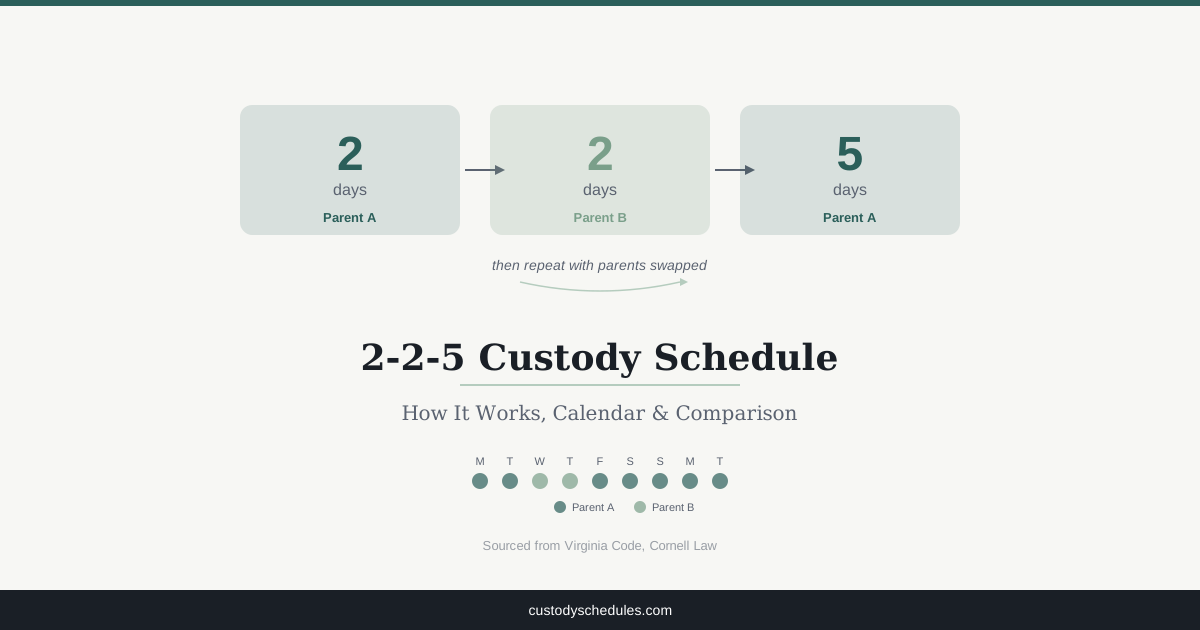
Picture a 50/50 custody schedulewhere each parent owns the same two weekdays every single week, and then a 5-day block — Friday through Tuesday — flips between households every other week. That's the 2-2-5:
- Parent A has the child every Monday and Tuesday.
- Parent B has the child every Wednesday and Thursday.
- The 5-day block (Friday through the following Tuesday) alternates between parents every other week.
Because each parent's weekdays are locked in, you always know who handles Monday school drop-off and who covers Thursday soccer practice. The only moving piece is the weekend, and even that follows a predictable every-other-week rhythm.
Courts in California include this among the shared custody arrangements recognized for equal parenting time, and it's one of the most common 50/50 patterns used in joint physical custody orders nationwide.
How the 2-2-5 Rotation Works
| Week | Mon | Tue | Wed | Thu | Fri | Sat | Sun |
|---|---|---|---|---|---|---|---|
| Week 1 | A | A | B | B | B | B | B |
| Week 2 | A | A | B | B | A | A | A |
Count it up: in Week 1, Parent A has 2 overnights (Monday, Tuesday) and Parent B has 5 (Wednesday through Sunday). In Week 2, Parent A picks up Friday through Sunday plus their regular Monday-Tuesday — 5 overnights — while Parent B gets their usual Wednesday-Thursday. Over the full two-week cycle, each parent lands at exactly 7 overnights.
The real advantage is that weekdays never change. Parent A is always Monday-Tuesday. Parent B is always Wednesday-Thursday. Your child's teacher sends Monday homework updates to the same parent every single week. The dentist knows who to call on a Thursday afternoon. That stability — the kind that makes a 6-year-old stop asking "wait, whose house tonight?" — is worth more than parents expect when they first design the rotation.
Want to map this onto real calendar dates? Our custody schedule generator prints 12 months of any rotation with your actual start date plugged in.
Best Ages for a 2-2-5 Schedule
One dad on r/Custody put it plainly: "My daughter handled 2-2-3 fine until pre-K, but switching homes three times a week while adjusting to a classroom was too much. We moved to 2-2-5 and it was the right call." That matches what developmental research suggests about school-entry transitions — fewer logistics, more routine.
Ages 4 to 8 are the sweet spot. Children in this range can handle a 5-day stretch away from one parent without the distress younger toddlers experience, but they still benefit from seeing both parents within every 7-day window. The Oregon Judicial Department's parenting plan guide recommends shorter, more frequent contact for children under 3 and gradually longer blocks as they reach school age — the 2-2-5 fits neatly into that progression.
Under 3? Five days apart is almost always too much. A 2-2-3 custody schedule keeps the maximum separation at 3 days, which aligns better with early attachment needs.
For kids 9 and older — especially once they hit middle school — many families find alternating weeks is simpler. Fewer transitions mean less disruption to homework routines, sports schedules, and the social lives that start to matter around fifth grade. The 2-2-5 is genuinely a bridge schedule; most families outgrow it, and that's fine.
2-2-5 vs. 2-2-3 vs. Alternating Weeks: Which Fits Your Family?
All three schedules split time 50/50. The difference is how much disruption your child absorbs — and how much coordination falls on you.
| Factor | 2-2-5 | 2-2-3 | Alternating Weeks |
|---|---|---|---|
| Longest stretch away from one parent | 5 days | 3 days | 7 days |
| Exchanges per week | 2 | 2-3 | 1 |
| Fixed weekdays | Yes — same parent same days every week | Yes — same parent same days every week | No — weekdays alternate |
| Best age range | 4-8 | Toddlers through 5-6 | School-age (6+) through teens |
| Weekend equity | Full alternating weekends | 3-day weekend alternates | Whoever has that week gets the weekend |
| Packing & logistics | Moderate | Heavy | Light |
On nearly every dimension, the 2-2-5 splits the difference — fewer weekly exchanges than the 2-2-3 while keeping separations shorter than alternating weeks. Think of it as the Goldilocks rotation for the pre-K-through-second-grade window.
For a different kind of balance — one where time isn't split equally but one parent carries more weekday responsibility — look at the 60/40 custody schedule.
Pros and Cons of the 2-2-5 Parenting Plan
What works
- Weekday predictability. Schools, daycare centers, and after-school programs always know which parent is the point of contact on a given day.
- Fewer transitions than a 2-2-3.Two exchanges per week instead of three means less packing, less driving, and less disruption to your child's evening routine.
- Both parents get real weekends. The 5-day block always includes a Friday-Saturday-Sunday stretch, so both parents get birthday parties, Saturday morning pancakes, and lazy Sundays — just on alternating weeks.
- Equal time, clean math. 182.5 overnights per parent per year. Courts appreciate that clarity; it removes one potential argument entirely.
What to watch for
- The 5-day gap can be tough on younger kids. A child who just turned 3 may struggle going Wednesday through Sunday without seeing the other parent. A mid-block video call or brief dinner visit during the longer stretch helps.
- Proximity matters more than people expect. With exchanges happening twice a week plus school drop-offs from both homes, parents who live more than 20 minutes apart will burn significant time — and that friction compounds quickly over months.
- Holiday planning takes deliberate effort.The 5-day block doesn't always line up with three-day holiday weekends. Write a separate holiday schedule into your parenting plan — don't assume the base rotation handles it.
- Vacations require coordination. Planning a week-long trip means negotiating a schedule swap. With alternating weeks, each parent already has a natural 7-day window to work with.
Making the 2-2-5 Work
A parent on r/Custody shared something that stuck: "We color-coded the fridge calendar — green for Mom days, blue for Dad days. Our 5-year-old checked it every morning and never once asked 'whose day is it?' after the first month." Visual anchors like that do more than any explanation you can give a kid.
Beyond the fridge calendar, a few strategies families on this rotation consistently recommend:
Use a dedicated co-parenting app to track the rotation and log exchanges. OurFamilyWizard is worth the subscription if your relationship has any friction — it stores timestamped communication records that hold up in court if disputes arise later. Low-conflict co-parents often get by with a shared Cozi calendar instead, which is free and works from any phone.
Keep duplicate essentials at both homes.Toothbrush, school uniform, favorite stuffed animal — buying two of the basics eliminates the "we forgot it at Dad's house" scramble. For the 2-2-5 specifically, this matters because the 5-day block is long enough that your child fully settles into one home before resetting at the other.
Lock in a Friday handoff time and protect it. Friday is the pivot day — it's when the 5-day block starts. A 3:00 PM school pickup works well because neither parent has to coordinate a special trip; the child leaves school with one parent and doesn't return to the other home until the following Wednesday.
Finally, write a schedule review clause into your parenting plan. Agree that both parents will revisit the rotation when your child enters first grade, or at whatever milestone makes sense for your family. The 2-2-5 is a bridge schedule — most families eventually shift to alternating weeks, and having that conversation already planned prevents it from becoming a conflict later.
How to File a 2-2-5 Parenting Plan
Handshake deals fall apart the first time someone wants to swap a weekend. Get the schedule into a court order. Virginia's Code § 20-124.3 lists ten factors courts weigh when evaluating custody arrangements — including each parent's willingness to support the child's relationship with the other parent. A cooperative plan that reflects equal involvement works in your favor.
- Map the calendar first. Use our custody schedule generator to print 12 months of your 2-2-5 rotation with actual dates. Bring this to your co-parent conversation — seeing real dates surfaces conflicts (like a Wednesday holiday that falls during Parent B's block) that abstract planning misses.
- Draft the full parenting plan. The weekly rotation is just the starting point. You also need holiday provisions, vacation rules, decision-making authority, communication protocols, and a dispute resolution process. Our parenting plan template walks through every required section.
- Both parents sign.An agreed plan moves through the court faster than a contested one. If you can't reach agreement, most courts will order mediation before scheduling a hearing.
- File with your county family court. Submit the plan as part of your divorce or custody petition. For modifying an existing order, file a motion to modify custody and attach the new schedule.
- Attend the hearing if required.Uncontested plans are frequently approved without a full hearing. If the judge asks about the 5-day block and your child's age, be ready to explain that it reduces transitions compared to a 2-2-3 while still keeping both parents present every week.
- Distribute the signed order.Once a judge signs the plan, it's legally binding. Provide copies to your child's school, daycare, and regular caregivers so everyone knows which parent is responsible on which days.
Related Reading
- Complete guide to 50/50 custody schedules — compare all four major equal-time rotations side by side
- 2-2-3 custody schedule — the shorter-rotation alternative for toddlers and younger children
- 60/40 custody schedule — how unequal splits work when one parent needs more weekday time
- Parenting plan template — everything that goes into a court-ready custody agreement