Your mediator just asked a question you weren't prepared for: "What co-parenting schedule do you want?" You knew you wanted to stay involved. You knew your ex wanted the kids during the school week. What you didn't know is that there are seven common arrangements — each with different overnight counts, exchange frequencies, and direct implications for child support.
This guide covers every major co-parenting schedule, which situations each one actually fits, and how to make your choice enforceable.
What Is a Co-Parenting Schedule?
A co-parenting schedule is the calendar that defines which parent has the child on which days. It's the core of every parenting plan template — the section judges look at first and the one that drives child support calculations in most states.
The schedule operates on three layers: the base rotation (your normal weekly pattern), holiday overrides (Thanksgiving, winter break, birthdays), and summer arrangements — which often shift to longer blocks to accommodate travel and camps. Get the base rotation right and the other two layers become much easier to negotiate.
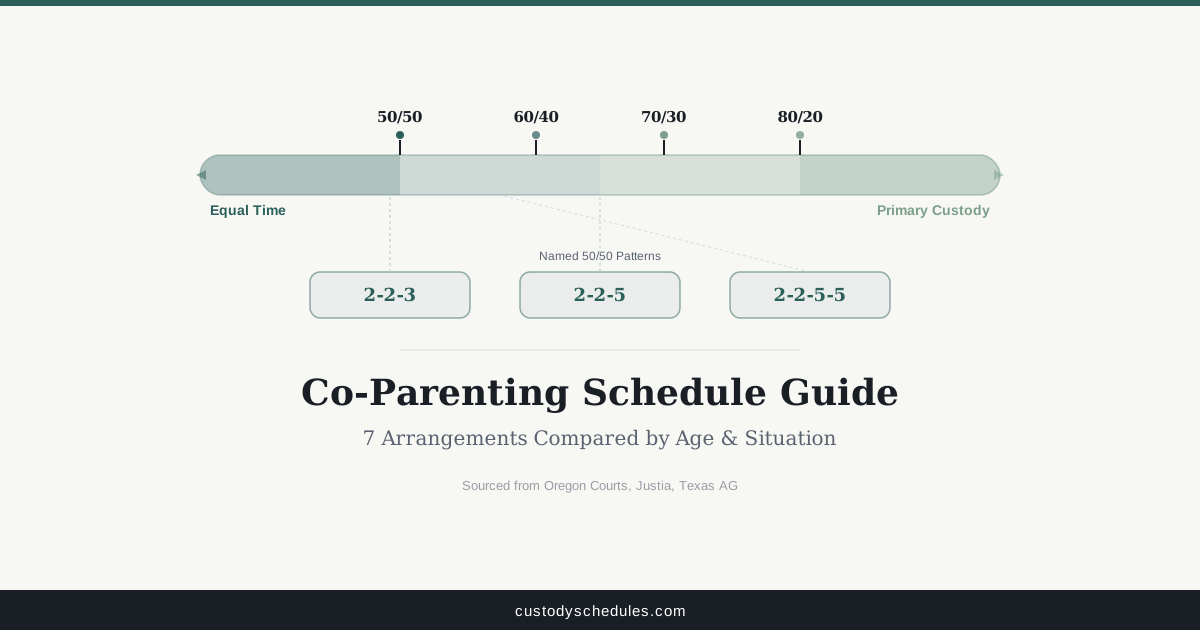
Every co-parenting schedule lands somewhere on a spectrum from equal time (50/50) to primary custody (80/20 or more). Where yours falls depends on your child's age, the distance between homes, each parent's work schedule, and — honestly — how well you two communicate on a bad day.
7 Co-Parenting Schedules Compared
Below is every major arrangement, ranked from equal time to primary custody. Each links to a full guide with sample calendars, age recommendations, and filing instructions.
| Schedule | Split | Overnights/Year | Exchanges/Week | Best Ages |
|---|---|---|---|---|
| 2-2-3 custody schedule | 50/50 | 182 each | 2–3 | 1–5 |
| 2-2-5 custody schedule | 50/50 | 182 each | 2 | 4–8 |
| 2-2-5-5 custody schedule | 50/50 | 182 each | 2 | 3–8 |
| 50/50 alternating weeks | 50/50 | 182 each | 1 | 6+ |
| 60/40 custody schedule | 60/40 | 219 / 146 | 1–2 | All |
| 70/30 custody schedule | 70/30 | 255 / 110 | 1 | All |
| 80/20 custody schedule | 80/20 | 292 / 73 | EOW | All |
The 50/50 Schedules
Equal-time schedules come in four flavors. The difference is rhythm — how often your child switches homes and how long they stay each time.
The 2-2-3 custody scheduleis the go-to for young children. Your toddler never goes more than three nights without seeing each parent. One parent on r/Custody put it this way: "Exhausting to explain to grandparents, surprisingly easy once you're actually living it." The real trade-off is exchange frequency — both homes need to be close to school and daycare, or the commute becomes the problem.
The 2-2-5 custody schedule and 2-2-5-5 custody schedule give each parent fixed weekdays plus alternating 5-day blocks. Your child always knows where they're sleeping on a Tuesday. Both work well for preschoolers through early elementary, and the predictability tends to reduce low-grade anxiety around transitions.
Alternating weeks is the simplest 50/50 option: one exchange per week, seven days at each home. Fewer transitions, fewer forgotten backpacks. Best suited for school-age kids and teenagers who can handle a full week away from one parent without it affecting sleep or schoolwork.
60/40 Through 80/20
Not every family fits a 50/50 mold — and courts don't require it.
A parent who travels Monday through Thursday, lives 45 minutes from school, or is still getting stable footing after a separation may genuinely serve their child better with a 60/40 custody schedule or 70/30 custody schedule while working toward more time. The schedule can evolve. Many families start at 70/30 when children are very young and revisit the split once the kids are in school and logistics change.
An 80/20 custody schedule— typically every other weekend plus occasional midweek time — is most common when one parent lives out of state or has a work schedule that makes weekday caregiving impractical. It's also a recognized starting point for parents who are building toward more parenting time through a step-up custody modification.
The overnight count matters more than most parents realize. Moving from 80/20 to 70/30 — gaining 37 more overnights per year — can meaningfully shift the child support calculation in most states.
How to Choose the Right Co-Parenting Schedule
Three variables narrow the field quickly.
Your Child's Age
Under 3, attachment research points toward shorter separations. The 2-2-3 custody schedule caps any block at three consecutive nights, which is why Oregon's parenting plan guide specifically recommends it for children under 36 months. By school age, all seven arrangements are on the table. By the teen years, alternating weeks usually wins — teenagers want a stable home base and they resent packing a bag mid-week.
Distance Between Homes
Same school district? Any schedule works logistically. Once you're 30-plus minutes apart, high-frequency rotations like the 2-2-3 create commute fatigue for both you and your child. That's when a 60/40 custody schedule with a school-week block starts making more practical sense.
Different states entirely? An 80/20 custody schedule with extended school breaks is typically the most workable option. The Texas Attorney General's standard possession order is a well-known example of a long-distance-friendly schedule template — worth reading even if you're not in Texas.
Conflict Level
Every exchange is an opportunity for friction. If communication is tense, fewer transitions reduce the flash points. A 60/40 schedule with one weekly exchange creates far less contact than a 2-2-3 with three per week.
One approach that works well for high-conflict situations: use school as the handoff point. One parent drops off in the morning, the other picks up in the afternoon. The parents never have to be in the same parking lot. It sounds minor, but parents on r/Divorce consistently describe this as "the single change that made the schedule actually survivable."
Making Your Co-Parenting Schedule Court-Ready
A verbal agreement is worth nothing if your co-parent changes their mind. Here is how to make yours enforceable:
- Map it out visually. Use our free custody schedule generator to build the calendar before you finalize anything. Seeing 12 months of actual dates exposes problems — like a school conference landing on an exchange day — that are completely invisible in the abstract.
- Write a parenting plan. The schedule is one section. You also need holiday rotations, decision-making authority, communication rules, and a dispute resolution process. Our parenting plan template covers all nine sections courts expect to see.
- Specify exact times and locations."Every other weekend" is not enforceable. "Friday at 6:00 PM through Sunday at 6:00 PM, exchanged at the school parking lot" is.
- File with your county family court.Both parents sign the plan, submit it with your custody filing, and a judge approves it. Once signed, it's a court order — violating it has real legal consequences.
Co-Parenting Tools That Help
The schedule is just the start. Keeping it running day-to-day requires a system both parents will actually use — not just the one who set it up.
OurFamilyWizard ($149/year per parent) is the platform judges name directly in court orders. It logs every message with a timestamp, tracks shared expenses, and includes a ToneMeter that flags hostile language before you hit send. If an attorney is involved or your situation is high-conflict, OFW is the safe default — and that paper trail has real value if you ever need to go back to court.
TalkingParents offers a free tier with court-admissible messaging — a strong option when you need documentation without OurFamilyWizard's annual fee. For a side-by-side breakdown of both, see our co-parenting app comparison.
For schedule creation, our custody schedule generator is free. Build any arrangement, print a PDF, and share the link with your co-parent or attorney before your next mediation session.
Related Reading
- 50/50 custody schedule — four equal-time patterns compared
- 2-2-3 custody schedule — the most common rotation for young children
- 60/40 custody schedule — when equal time doesn't match real life
- Parenting plan template — how to put your schedule into a court-ready document